1 · The core idea in thirty seconds
Strip away the coins and the headlines, and a blockchain is simple: a record book that many parties share, where old entries can't be quietly rewritten. Everyone holds a copy, new pages (blocks) are agreed upon by rules instead of by a single boss, and changing history would mean rewriting every copy at once. That's it. Every legitimate use of the technology is some version of: people who don't fully trust each other need to trust shared records.
2 · How it actually works — hashes, blocks, agreement
Three ideas carry the whole mechanism:
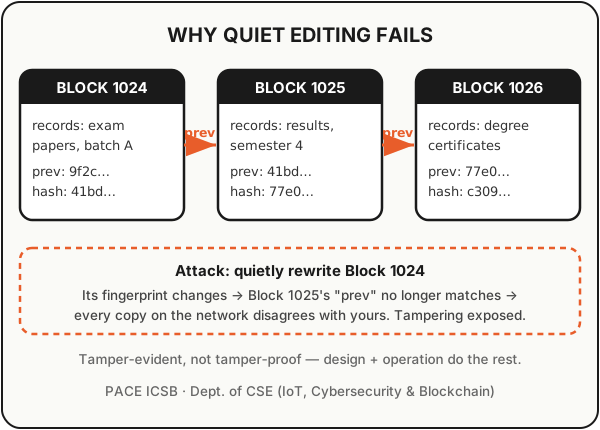
- Fingerprints (hashes). A hash function turns any data into a short fixed fingerprint. Change one comma in the records and the fingerprint changes completely. That is what makes quiet editing detectable.
- Chained blocks. Records are grouped into blocks, and each block stores the fingerprint of the previous one. Alter an old entry and its block's fingerprint breaks — which breaks every block after it. Tampering leaves evidence by construction.
- Agreement rules (consensus). Instead of one boss approving new pages, the network follows shared rules for accepting the next block. Different networks use different rules, trading speed against decentralization differently.
Two nuances beginners usually miss. First, tamper-evident is not tamper-proof — small or poorly run networks can still be overpowered, keys can still be stolen, and buggy smart contracts fail regardless of the ledger underneath. Second, not all blockchains work identically — public networks anyone can join behave differently from permissioned ones run by known organizations. The pattern in the callout below holds for both; the engineering differs.
3 · Five real uses worth knowing
- Credentials that can't be faked. Degrees, certificates, licenses — issued once on a ledger, verifiable by any employer in seconds, without calling the issuing office. Fake certificates become a non-problem.
- Supply-chain traceability. Each handoff of a product — farm, truck, warehouse, shelf — recorded as an entry. Contaminated batch? Trace it in minutes instead of weeks.
- Tamper-evident records. Land registries, audit logs, exam papers: documents whose entire value depends on nobody having altered them after the fact.
- Self-owned identity. Prove you're eligible (over 18, an enrolled student, a licensed driver) without handing over the underlying documents to every verifier.
- Agreements that execute themselves. Smart contracts release payment when delivery is confirmed, royalties when a song plays — no intermediary taking a cut or a month.
4 · Student proof — exam-paper protection
This isn't abstract for us. At PACE NIRMAAN 2025, ICSB students Muhammad Haashid and Mohammed Saahil S. M. took first place with a blockchain-based approach to protecting examination papers — attacking exactly the centralization risk described above: one compromised store, and the integrity of an entire exam collapses. Their project maps use-case #3 one-to-one: papers whose integrity every party can verify, with no single point of quiet tampering. See Built at ICSB for the project lineup.
5 · When not to use it — honestly
A good engineer also knows when to say no. Don't reach for a blockchain when a normal database works: single-owner data, high-speed transactions, content that must be deletable (hello, privacy law), or prototypes where a spreadsheet would do. Blockchain is a trust tool, not a speed tool — slower and more complex than a database by design, because decentralized agreement costs something. Use it where the trust problem justifies the price.
6 · Try it yourself — verify, don't trust
A fifteen-minute drill that teaches the core idea better than any video. Goal: see tampering evidence with your own eyes.
- Break a fingerprint. Open any SHA-256 demo tool and hash the sentence The exam paper is sealed. Hash it again with one letter changed. Different fingerprint — that gap is the entire security argument for tamper-evidence.
- Read a real ledger. Open any public test-network block explorer and pick a transaction. Note its block number, then follow the link to the previous block. That backward chain of fingerprints is exactly what section 2 described.
- Write the one-paragraph report. What did you look at, what linked to what, and what would an attacker have to rewrite to fake it? That paragraph is the skill; the explorer was just typing.
7 · FAQs
Is blockchain the same as Bitcoin?
No. Bitcoin was the first major application; blockchain is the underlying record-keeping method. Conflating the two is the most common beginner mistake — and the reason section 2 came before the use cases.
Is blockchain unhackable?
No. The shared record is tamper-evident, not tamper-proof. Small networks can be overpowered, smart-contract bugs get exploited, and stolen keys bypass the ledger entirely. Treat "unhackable" as marketing, not engineering.
When does a normal database win?
Single owner, high transaction speed, data that must be deletable, or an early prototype — database, every time. Reach for a ledger only when shared records plus tampering risk both exist.
Do I need cryptocurrency to learn blockchain?
No. Everything above can be learned on test networks with valueless tokens. Never touch real funds while learning.
8 · Sources & further reading
- NITI Aayog — Blockchain: The India Strategy, Part I — applied framing.
- Nakamoto — "Bitcoin: A Peer-to-Peer Electronic Cash System" — the original mechanism description.
- NISTIR 8202, Blockchain Technology Overview — neutral technical reference; verify you are reading the latest revision.
Want to go deeper? That's what our Blockchain & Web3 track covers — fundamentals first, then smart contracts, tokens, dApps and real architectures. Still deciding between fields? Read our IoT vs cybersecurity vs blockchain comparison first.