If you are shortlisting CSE specializations, you have seen IoT, Cybersecurity, and Blockchain listed both separately and as one combined program. They are not three isolated careers. In real products, connected devices need security, and security increasingly uses tamper-evident, decentralized records. Choose by the problems you enjoy — not by which term sounds newest.
1 · Short answer
No single track is best. IoT suits hardware builders, cybersecurity suits adversarial thinkers, blockchain suits transaction-system designers — and at P. A. College of Engineering, CSE (IoT and Cyber Security including Blockchain Technology) is a single integrated B.E. program established in 2023 with an intake of 60, per the official department page. So the decision is not "pick one on day one." It is: build a common CSE foundation, then lean into the track that fits you.
2 · What each field actually involves
Internet of Things
IoT is about physical systems that sense, communicate, and act — sensors, microcontrollers (Arduino, Raspberry Pi), gateways, and cloud dashboards. A useful test: does seeing software move hardware excite you? Roles split into device-side (firmware, embedded), platform-side (gateways, cloud), and data-side (analytics, automation).
Cybersecurity
Security is about protecting systems from unauthorized access and misuse — networks, cryptography, hardening, monitoring, incident response, forensics. You will meet frameworks like NIST CSF, CISA guidance, OWASP, and MITRE ATT&CK during the degree (not before joining). It rewards detail-orientation and continuous learning, because threats and tools keep changing.
Blockchain
Blockchain is about verifiable, tamper-evident records without a single central operator — ledgers, hashing, smart contracts, DApps. NITI Aayog frames it as a means to re-engineer processes, not an end in itself. Roles are fewer and more concentrated than general software or security operations, and they reward strong fundamentals plus a public portfolio.
3 · Side-by-side comparison
Typical emphasis — individual colleges and employers vary:
| Criteria | IoT | Cybersecurity | Blockchain |
|---|---|---|---|
| Central question | How do devices sense and act reliably? | How do we prevent, detect, respond? | How do we prove what happened? |
| You build | Sensor prototypes, dashboards | Hardened systems, test reports | Smart contracts, DApps |
| You debug | Wiring, signal, connectivity | Logs, configs, vulnerable code | Contract logic, key management |
| Hardware | Yes, for real depth | Laptop + labs usually enough | Laptop + test networks |
| Entry funnel | Broad via embedded + cloud | Broadest via analyst / SOC / IT support | Narrower, portfolio-driven |
On salaries: you will see specific LPA figures on many blogs. They vary by city, company, and skills, and we do not publish unverified numbers here. Ask for audited, role-wise placement disclosures during counselling instead of trusting screenshots.
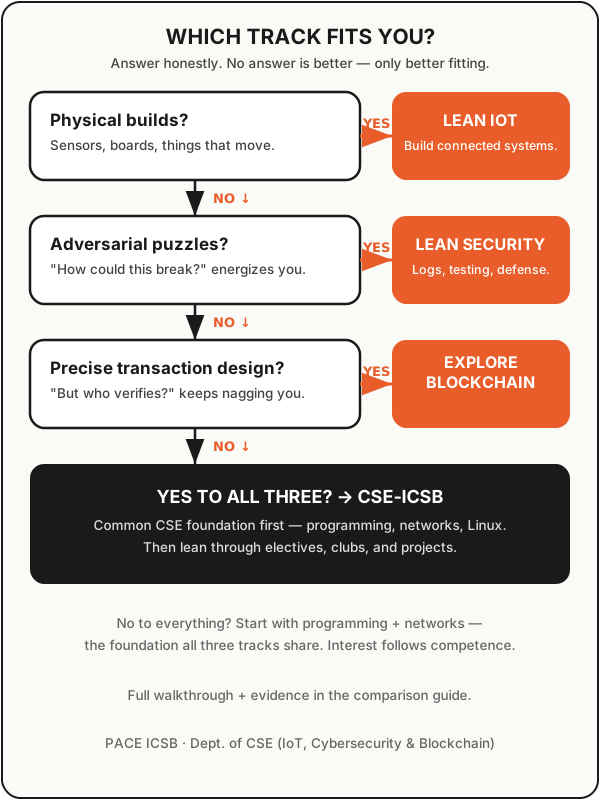
4 · Which suits you? A 2-minute self-check
- Physical builds or screen-only? Wiring a sensor and seeing live data → IoT. Logs and analysis → security.
- Do you enjoy adversarial thinking? "How could this break?" energizes you → security.
- Do you enjoy high-stakes precision? Slow, careful design and testing → blockchain development.
- What have you already enjoyed? Python + puzzles → security or blockchain. Electronics kits → IoT. Web + databases → any of the three.
A common pattern: go broad in year one (programming, networks, Linux), then specialize through electives, clubs, and projects in years two to four.
5 · How PACE ICSB teaches all three — verified examples
From our official department page:
- Hands-on IoT labs with Arduino and Raspberry Pi boards, Wi-Fi modules, sensors and actuators.
- Security practice: "Advanced Penetration Testing & Ethical Hacking" workshop, "Code, Exploit, Defend" mastery workshop, and C-DAC expert session on Intelligent Identity of Things.
- Blockchain proof: student team secured Second Runner-Up at a national blockchain hackathon at IIT Kharagpur, competing against IIT/NIT teams.
- Cross-domain wins: Hack0-to-Future 4.0 runner-up, VEXSTORM26 AI hackathon first prize, IEEE YESIST12 first place advancing to global finals.
6 · 5-question decision framework
- Which demo would you proudly show a friend — a sensor dashboard, a fixed vulnerability report, or a DApp transaction?
- Are you willing to learn networking and Linux deeply? Required for security, helpful everywhere.
- Do you want hardware weekly? If no, avoid a hardware-only path.
- Do you have patience for audit-style precision? Required for blockchain and security.
- What proof will you build each semester — prototype, lab notebook, or repo?
How the framework plays out — three illustrative sketches, not real students:
- The tinkerer lights up at sensor dashboards and weekend hardware builds, and dreads log files → lean IoT, and borrow security habits early.
- The puzzler enjoys rule-loophole games and spots weak assumptions fast → lean security, and keep building software alongside.
- The systems thinker asks "but who verifies this?" about every transaction → explore blockchain, and double down on backend fundamentals.
If all three sound good, that is a signal for an integrated program rather than a narrow single track. Pair this post with our ethical hacking starter map, IoT sensors-to-cloud explainer, and blockchain beyond cryptocurrency.
7 · FAQs
Is this one degree or three?
One B.E. program under CSE at PACE that integrates all three domains. Confirm current affiliation, intake, and syllabus version with admissions for your batch.
Which has more jobs?
Entry security-operations and general software funnels are typically broader than pure blockchain-developer openings, but demand shifts yearly and by city. We avoid vacancy counts here because live auditable figures were not verifiable at writing time.
Can I switch lean later?
Yes — strong first-two-year fundamentals (programming, networks, OS, databases) plus electives and projects are the switching mechanism.
What should I learn before joining?
Python basics, Linux navigation, networking fundamentals, and Git/GitHub. One small documented project beats any number of certificates.
Sources & further reading
- PACE Dept. of CSE (IoT, Cybersecurity & Blockchain) — program facts, labs, workshops, student wins.
- NITI Aayog — Blockchain: The India Strategy, Part I — policy context on applied blockchain.
- Framework references for lab work: NIST Cybersecurity Framework, CISA IoT guidance, OWASP Top 10, MITRE ATT&CK — always verify the latest version before citing.
Bottom line: do not ask only what pays most this year. Ask what you will practice for four years — making devices work, breaking and fixing systems safely, or proving transactions correctly. If you want all three foundations, talk to us about CSE-ICSB eligibility and counselling timelines.